Care and Feeding of Your Piano
Your piano is an object of beauty, a source of enjoyment, and a significant investment. For all those reasons, it's important to take proper care of it. However, caring for your piano is more a matter of conscientious attention than hard work.
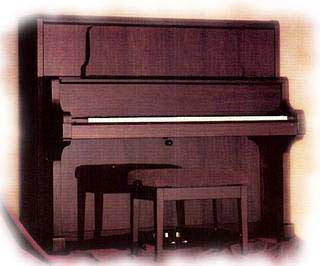
You can make an enormous difference in the life of your piano on the day it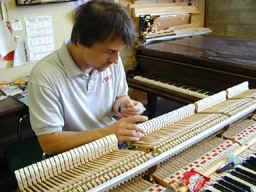 arrives at your home--by deciding where to put it. Severe changes in humidity can cause dimensional changes in the wooden parts of your piano, and can affect not only the instrument's day-to-day performance but also its longevity. Choose a location that will not subject the instrument to extreme temperature or humidity changes. That means keeping your piano away from windows, outside doors, fireplaces and heating or cooling vents. Using a room humidifier in the dry winter months and a room dehumidifier in the moister summer months can add protection against humidity-related effects.
Though a piano can be a showcase for the best of the cabinetmaker's art, don't confuse it with a regular piece of furniture. Don't place or store objects on your piano, especially not food, drinks or plants (which contain moisture).
Do, however, dust it regularly with a soft cloth or lambs wool duster. Avoid using sprays or polishes; some of them will make future repairs difficult if they are absorbed into the wood, and all of them can produce mists that will damage the working parts inside your piano. If the inside appears to need cleaning, or if a small object has fallen inside, call a technician for help. You can clean (but never wash) the keys using a small amount of mild detergent and water.
To get the best performance out of your piano, make sure to have it serviced regularly by a qualified technician. In the first year after purchase, have the piano tuned at least three times, to account for its acclimation to your home's environment. After that, have it tuned at least once a year. A piano should be tuned to A-440 cps, or standard pitch, but pitch is only one variable that your technician can adjust. Tone, or voicing, can be improved through adjustments to the strings and hammers. Touch, or the way the keys feel when played, can be improved if necessary through adjustments to the 9,000 moving parts in the piano's action.
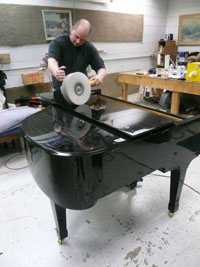 If you need to move your piano, lift it while moving it to avoid putting undue stress on the legs. If you have to move it across a finished wooden floor, over a threshold, or up or down more than one or two steps--or, of course, to a different building--call a professional piano mover.
Sometimes, particularly on grand pianos, one is tempted to touch the strings. Don't! The natural oils on your skin can get on the strings and lead to corrosion.
Finally, play! With use, all pianos become more brilliant and acquire a distinctive voice. So when you sit down for a session at the keys, you're actually improving the beauty of your most beautiful investment.
***